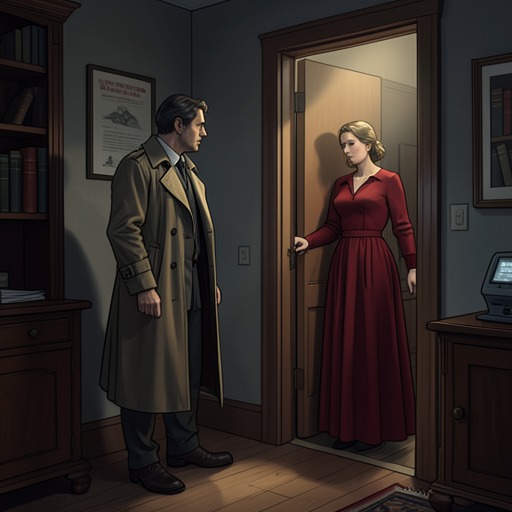
Elizabeth Mourning-Walters
I'm Still Here- What didn't kill me made me stronger and sharperElizabeth Mourning-Walters is the socially admired wife of Robert Walters and the force behind the violent reckoning that follows his affair with Janae Morrison. Presented publicly as accomplished, elegant, and compassionate, she privately becomes a woman consumed by betrayal, jealousy, and rage. Her decisive significance lies in the contradiction she embodies: she is both the respected doctor whose image commands communal trust and the wife who commissions an attack on Janae before ultimately shooting Robert herself.
Public Identity and Marriage
Elizabeth is identified as Dr. Elizabeth Mourning-Walters, or Dr. E, and is surrounded by markers of professional and social status. She holds a Ph.D., is described as beautiful and well liked by the community, and moves through public life with the confidence associated with wealth and respectability. Her clothing and accessories at the confrontation with Brick include two-hundred-dollar boots, a Michael Kors purse, a large diamond ring, matte lipstick, and tightly arranged hair. These details establish a carefully maintained public image rather than a marginal or powerless figure.
That image also shapes the community’s first response to Janae’s accusation. Robert declares at a press conference that his relationship with Janae was only business, denies sleeping with her, and presents himself as someone attempting to rescue a troubled woman. He invokes his loyalty to his wife, while Elizabeth’s reputation makes the denial persuasive. Janae observes that Elizabeth is loved by everyone in her presence and possesses the education, beauty, light skin, and socially approved body that the public uses to measure credibility. The contrast leaves Janae dismissed as a supposedly unstable woman with an overactive imagination, showing how Elizabeth’s status protects the marriage’s appearance even after its private foundation has broken.
The Affair and the Demand for Removal
The truth is that Robert and Janae were lovers. Their relationship included repeated sexual encounters and shared drug use, but it also involved emotional and material investment: Robert bought Janae art supplies, paid for art classes, took her to New York to see artists associated with the Harlem Renaissance, and told her that he loved large women and could not live without her. He also had a portrait Janae painted hanging in his office. Elizabeth’s friendship with Janae deepens the betrayal, because Elizabeth had bought Janae clothes and shoes and introduced her to an elite social circle while remaining unaware, or at least publicly unaware, of the relationship.
When Elizabeth approaches Brick, she is no longer merely defending a marriage’s public image. Money has already been transferred to Brick’s bank account, and she hands him Janae’s picture with the direct instruction, “Get rid of Janae Morris.” She is described as scorned, wealthy, petite, and emotionally distraught, arriving with red eyes and a runny nose beneath the polished appearance signaled by her expensive clothing and jewelry. Her demand turns private humiliation into a planned act of violence and places Brick inside the conflict as the intended agent of her revenge.
Elizabeth’s explanation reveals a possessive understanding of the threat. She says that Janae must stay away from her and her husband, while also acknowledging that Robert will receive his own punishment. The transaction therefore contains two aims at once: preserving distance between Janae and the Walters household and retaliating against the husband who made that separation necessary. Her command is not an isolated expression of anger but a concrete attempt to control the consequences of Robert’s desire.
Robert Walters’s Death
The plan against Janae does not resolve Elizabeth’s injury. Later, while Jensen Brick McCall is in Los Angeles, news breaks that Robert has been found dead from a single gunshot wound to the head. Social media initially describes the death as self-inflicted, but Elizabeth admits that she shot him. The confession follows the exposure of the affair and confirms that the violence has turned inward toward the husband whom she had publicly defended.
Asked why she killed Robert, Elizabeth answers with a compressed account of her emotional state: “Rage, hatred and anger mixed with love.” The formulation makes the killing neither a simple act of hatred nor an uncomplicated defense of marriage. Love remains present inside the rage, which helps explain why her public statement is saturated with contradiction. She says that she is tired of Robert’s affairs and lies, speaks of the women drawn to him, and admits that she still loves him and prays for him. Her anger is directed at Robert’s betrayal, at the women associated with it, and at her own blindness to what was happening around her.
The murder has a direct effect on Jensen. Robert had been Jensen’s first love, and the news leaves him physically distressed and emotionally stunned while he stays in the room provided by Ginger Pearl. Elizabeth’s confession also makes Jensen’s name circulate alongside Robert’s and Elizabeth’s, binding him publicly to the scandal. The reporter who had spoken with him advises him to leave, turning Elizabeth’s act into another displacement in Jensen’s already unstable life.
From Antagonist to Mother
Elizabeth’s place in Jensen’s story is inseparable from the revelation that Jensen’s “murderer” is his birth mother. Jensen explains that she attempted to abort him at twenty-six weeks; after the failed procedure, he was left in a dark room on a table to die. Grace, the nurse who first cared for him, saved his life, but Elizabeth allegedly instructed those caring for him to let him die. Jensen therefore names Elizabeth as his murderer not because she successfully killed him, but because her attempted rejection becomes the central wound through which he interprets his existence.
Ginger Pearl recognizes the significance of Jensen’s account and understands that the woman in the photograph is the mother he has been seeking. His survival transforms Elizabeth from an absent biological parent into the figure at the center of his quest for purpose. Jensen says that finding his murderer ultimately enables him to find himself; the investigation is thus both a search for an explanation and an effort to convert abandonment into a survivable identity. Elizabeth’s earlier violence toward Robert exists within this larger pattern of life-threatening choices, but the novel does not erase the distinction between her marital rage and the original abandonment that Jensen carries.
The later family scene radically changes Elizabeth’s position. On Christmas Day, Janae gives birth to Grace Pearl McCall, and Jensen describes sitting among a family in which his murderer is now his mother. He says that Elizabeth understands the purpose of his survival and that he gives her his kidney so she can watch her younger children grow up. This act does not undo the attempted abortion or the years of abandonment; instead, it marks a conditional form of reconciliation in which biological relation becomes part of a new family structure rather than a return to the past.
Narrative Significance
Elizabeth is constructed through competing versions of the truth. Robert’s press-conference performance makes Janae appear unbelievable, while Janae’s account exposes the material and emotional history concealed beneath his public denial. Elizabeth’s own later confession then revises the scandal again, revealing that the wife who seemed to embody stability has acted from rage, hatred, love, and accumulated betrayal. Her character demonstrates how social reputation can conceal private violence without making the concealed violence less consequential.
Her connection to Jensen intensifies that instability. For him, the word “murderer” is not a legal label alone but an externalized name for the wound of being unwanted at birth. Therapy later challenges another such identity when Inya tells Jensen that he is not “bad energy,” but Elizabeth remains the most literal and emotionally charged figure attached to his naming of destruction. By the end, the family’s Christmas gathering, Jensen’s kidney donation, and the presence of his daughter place Elizabeth inside a story of survival that is neither simple absolution nor permanent estrangement. She remains the woman who tried to end Jensen’s life, yet she also becomes the mother whose continued life is sustained by the son she once refused to raise.